“Hard days are the best because that’s when champions are made.” Simone Biles
Olympics. The Winter Olympics officially started on February 6th, and boy, did we learn a lot about it. We first asked students, Would you rather be a great artist or a great athlete? Students knew the word ‘artist,’ but they were not familiar with ‘athlete.’ After clarifying what makes an athlete, we talked about the Olympic Games, which originated in Greece. We watched a short video about the history of the Olympics and learned about the Winter Olympics, which began in 1924. But what types of sports can we see at the Olympics? After hearing students’ answers, we briefly explored each sport: skiing, cross-country, figure skating, speed skating, snowboarding, hockey, bobsleigh, skeleton, luge, biathlon, curling, and ski mountaineering. We then asked them what winter sport they would like to learn, and the most popular ones were hockey and figure skating (or ballerina skating, as they called it, lol). We talked about the competition between countries, and how each country is represented by a flag, like the one we pledge allegiance to every morning. As a school, each class chose a country to commemorate the Olympics with a symbolic opening ceremony, and we chose Kyrgyzstan, proudly represented by two of our students. We learned about the colors of the flag: bright red (which symbolizes bravery and valor) and a yellow sun (which represents peace and prosperity) centered. Together, we took turns painting two large flags for our school parade. This year, Kyrgyzstan is competing in two categories: alpine skiing and cross-country skiing. Go Kyrgyzstan! We will keep track to see how the athletes do.


Hibernators. We began our week talking about another hibernator from the squirrel family, the groundhog! We learned that they’re also known as woodchucks, marmots, whistlers, whistle pigs, and many other names. (Ask your child why they’re called whistle pigs.) Groundhogs live in the forest in places that go through all four seasons, and spend most of their time in their burrows. We then talked about an old German tradition that is known as “Groundhog Day”. People wake up a groundhog named Phil and see if Phil can see his shadow (Ask your child what it means when Phil sees his shadow). We read books about Groundhog Day, and we watched a 2-minute video about the event. We cheered for Phil and waited to see if he’d see his shadow, and he did, which means six more weeks of winter. (booo!) To cheer ourselves up, we learned how to draw a groundhog, cut it out, and paste it on a popsicle stick, and decorated a plastic cup so our groundhog could come out of the burrow.
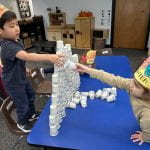
100. We hit our 100 days of school, and we celebrated on Friday. We practiced by counting, of course, we counted by ones while we exercised, we counted as we danced, and we counted just for fun. We talked about how much easier it is to count by tens than by ones. And finally, we had a STEM challenge using one hundred cups! Students joined their teams to work together on their projects to see who could build the tallest tower using only 100 cups. We talked about the difference between big and tall, and from there, we were ready to get to work. Once in their group, some students worked side by side, building their structures, but did not communicate with each other. We encouraged them to collaborate with their team and discuss their plan. When the teams finished their towers, they were disappointed because theirs were visibly shorter than the others’. We had a little talk about the importance of collaboration, cooperation, and respect for each other’s ideas. We discussed how the group whose tower was taller succeeded because they were working together. It was such a fun activity, and the idea of building a tall tower was extremely exciting for most. We are still learning to work together, and we will continue to encourage teamwork in other activities. “Teamwork teaches students the important skills needed to work together towards a common goal. It enhances their social skills and academic knowledge by learning about each other’s thinking processes.” Learning how to participate in a group and practice communication and listening skills is a life skill!




Other fun things we did:
-

- We learned facts about the Olympics from Mr. Joe’s class
-

- We visited Ms. Mary’s class and talked about the history of the Olympics
-

- We played Cover me up with dominoes
-

- We made heart explosions
-

- We celebrated Marco’s bday
Efi and Soraya